
Standard or Customized Equipment Case: How to Decide Before You Pay for Tooling
There are two expensive ways to get an equipment case wrong. The first is paying for a new mold when a standard shell would have done the job. The second is spending eighteen months living with a standard shell that is 12 mm too shallow, because nobody wanted to raise tooling in the first budget.
Both failures come from the same mistake: treating “standard or customized” as a product category rather than a decision with four levels. Most equipment programs sit at level one or two, and level three — a new mold — is rarer than the number of custom requests suggests.
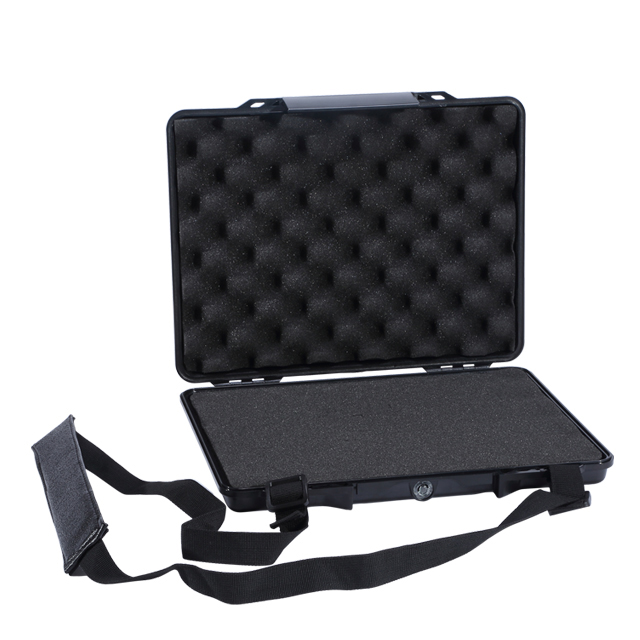
The four levels of customization
Customization is not one switch. It is a ladder, and the cost, lead time and risk change at every step.
|
Level |
What changes |
Typical lead time |
What drives the cost |
Use it when |
|
0 — Standard |
Nothing. Stock shell, stock foam or empty |
Stock sample around 5 days |
Unit price only |
Demo units, spares, low-volume or mixed kits |
|
1 — Standard shell, custom interior |
Foam cavities, divider insert, lid layout |
Custom insert sample around 2 weeks |
Cutting program and NRE, not tooling |
The kit is fixed but the shell is not |
|
2 — Standard shell, custom exterior |
Logo, color, nameplate, panels, compartments, openings |
Logo sample around 1 week; color slip around 1 week |
Print/mold inserts, minimum quantities |
Branded OEM delivery, service fleets, rental fleets |
|
3 — New mold |
Wall geometry, internal volume, features |
Around 60 days to open a mold |
Tooling plus validation |
No standard size fits the equipment, or volume justifies a unique format |
Most RFQs that ask for “a custom case” are actually level 1 or level 2 requests. That distinction is worth settling before anyone quotes, because it changes both the price and the calendar.
Check the standard ladder first
A standard case is only limiting if the ladder is short. Tsunami’s range runs from a 3.26-liter flat case to an 84.3-liter wheeled case, all sharing the same construction logic — PP + fiber shell, continuous O-ring, pressure equalization valve, stainless hardware:
|
Model |
Internal (L × W × D) |
Volume |
Depth split (base + lid) |
Weight with foam |
Sealing |
|
322505 |
325 × 233 × 43 mm |
3.26 L |
20 + 20 mm |
0.85 kg |
IP65 |
|
342413 |
341.7 × 237.7 × 125 mm |
10.2 L |
92 + 33 mm |
1.95 kg |
IP67 |
|
443419 |
444.7 × 345.8 × 190 mm |
18.6 L |
143 + 47 mm |
4.9 kg |
IP67 |
|
533120 |
530 × 310 × 200 mm |
32.8 L |
160 + 40 mm |
5.75 kg |
IP67 |
|
584433 |
580.6 × 439.6 × 328 mm |
84.3 L |
273 + 55 mm |
10.92 kg |
IP67 |
One caveat on the flat model: the 322505 is a 43 mm internal shell, and a flat case is specified against that internal depth rather than against the lid-and-base split, so confirm the split on the drawing before you plan a 40 mm panel into it.
Read that table as a filter, not a ranking. From 10.2 to 18.6 liters both footprint and depth grow (341.7 × 237.7 × 125 mm to 444.7 × 345.8 × 190 mm); from 18.6 to 32.8 liters the footprint stretches to 530 × 310 mm on a taller base; at 84.3 liters you get a case that wants casters, at more than twice the weight of the 443419.
The honest test is one line of arithmetic: take your largest item as packed, add the foam you cannot remove, and compare it to base depth — not total depth. If it fits inside one of the rows above with a sensible margin, the standard ladder has already answered the question, and a mold would be buying you nothing except a distinctive shape.
When standard is genuinely enough
Standard shells earn their place in more programs than buyers expect:
The kit changes. Demo units, loaners, service swaps and multi-product field teams rarely carry the same contents twice. A standard case with cubed foam or dividers adapts without a new specification each time.
Volumes are low or uncertain. A pilot batch of 20 units does not amortize tooling in any direction that makes sense.
The case is one of many sizes. Distributors and rental fleets standardize on a handful of sizes so that any case can hold any kit — the opposite of a dedicated cavity.
Speed matters more than fit. Stock samples ship in around five days; a new mold is a two-month program before the first part exists.
You need documented protection, not a shape. A standard model arrives with the test documentation already published for it — IP, dust and dry heat — issued against the configuration you are buying. A new mold starts that validation from zero.
When customization is the right call
Four situations justify moving up the ladder, and none of them is simply “our equipment is special”.
No standard size fits. Not “close” — fits. A 300 mm-wide instrument will not go into a 237 mm-wide cavity, and a unit that needs 200 mm of base depth cannot live in a case with a 92 mm base. One mismatched dimension wastes the volume of the whole case, and that waste ships on every order — in freight, in packing time and in the extra foam needed to stop the equipment moving.
The case is part of the product. For an OEM, the case is often what the customer opens first: the instrument, its accessories, its documentation and its branding arrive as one object. That is a level 2 job — custom insert, nameplate, logo, and a lid layout that presents rather than stores.
Repeatability is a contractual requirement. If every unit must ship identically, with the same part positions and the same checking routine, the interior has to be documented rather than improvised. That is when custom foam stops being a nice touch and becomes part of the quality system.
The equipment has to work from the case. Panels, connection points, openings and ventilation turn a case into a mobile workstation. No stock interior does that; it is a level 2 or level 3 design task and it changes how the shell is built.
What level 3 actually costs — in time, not just money
Tooling is the visible cost. The schedule is the one that hurts.
On the current Tsunami program the standard intervals are: stock sample around 5 days, logo sample around 1 week, custom color slip around 1 week, customized insert sample around 2 weeks, new mold around 60 days, bulk production around 20 days, and shipping around 12 days by air or 45–60 days by sea.
Put those in sequence and the arithmetic gets uncomfortable. A level 1 program can be sampled, approved and in production inside about five weeks. A level 3 program cannot produce a first article for two months, and the part still has to be tested, dropped, sealed and approved afterwards. If your launch date is fixed, the decision is not about tooling cost — it is about whether a mold can physically be ready in time.
That is the case for staging: start at level 1 or 2 on a standard shell for the first production run, measure how the kits are actually used, and tool a dedicated shell for the second generation when the volumes and the design are both settled.
The one technical risk that customization adds
A standard model is certified as tested. Once you add a panel, an opening, a cable port or a ventilation path, the shell has been modified, and the sealing performance of the modified configuration is a new question — not the one on the existing certificate.
Two rules keep this manageable:
1. Keep penetrations away from the gasket line and the latch load path. Both are structural to the seal, not just to the closure.
2. Re-validate what you changed. If the application needs a documented IP rating, the modified configuration needs its own test evidence, and that has to be in the project plan — not discovered at the shipping stage.
Custom foam and custom branding do not touch the seal. Custom openings do. It helps to say which of the two you are actually asking for.
Briefing a supplier so the first quote is the right one
Most quote cycles are wasted on missing information rather than price. Six items close the gap:
1. Equipment drawings or 3D models, including protrusions — connectors, knobs, mounts, handles that cannot be removed.
2. Weight and center of gravity per item, and the total loaded weight, so the format decision (hand-carry, casters, pull rod) can be made on evidence.
3. Depth budget per item, measured as packed, against base depth.
4. Mode of transport — courier, air, sea, internal van loop — and how many handling cycles the case has to survive.
5. Volume and repetition — one prototype, a pilot batch, or an annual program. This is what decides standard versus tooling, more than any drawing does.
6. Branding and documentation requirements — logo, nameplate, asset numbers, and which certificates the case has to arrive with.
With those six, a supplier can quote a level, not just a case. Without them, the only honest answer is a standard model and a disclaimer.
FAQ
Is a customized case always better than a standard one?
No. Customization buys fit and repeatability; it costs tooling, lead time and flexibility. If the kit changes, or the volume is low, a standard shell with a configurable interior is usually the better buy.
Can I get a custom interior without a new mold?
Yes — that is the most common configuration. A standard shell takes a custom-cut foam set or a divider insert, with logo, color and nameplate options on the outside, without any tooling for the shell.
How long does a custom case project take?
On the current program, a customized insert sample runs around two weeks and a logo sample around one week. A new mold takes around 60 days before the first part, plus bulk production around 20 days and shipping around 12 days by air.
Does customizing the case affect its IP rating?
Custom foam and branding do not. Any opening or panel does, because it modifies the sealed shell — the modified configuration needs its own validation if a documented rating is required.
What is the minimum order for custom colors?
Custom colors carry a minimum order quantity that depends on the shade and the model. Standard black models ship as stock samples in around five days.
Conclusion
The right question is not “standard or customized”. It is: which level does this program need, and what does that level cost me in lead time?
Start from the internal dimensions and the base depth, check them against the standard ladder, and only then decide whether the gap is worth tooling. In most equipment programs the answer is a standard shell with a custom interior — protection certified off the shelf, organization built for the equipment, and no two-month wait before the first article exists.
Most of Tsunami’s work sits exactly on that middle ground: a standard shell from the existing range, opened to a custom interior, then branded and documented for the OEM. Designing, tooling, testing and production run under one roof, which is what makes a two-week insert sample and a five-day stock sample possible from the same supplier. Hard-case bodies carry a lifetime warranty.
Send us your equipment drawings and quantities and we will tell you which level your program actually needs — including the cases where the answer is a standard model.

At the end of the article, there is a large release of the latest e-catalogue. Identify the QR code to download the plastic hard cases latest e-catalogue. Don’t miss it ~
Scan the QR code below to get the latest e-catalogue ~
E-mail: info@tsunamicase.com
WhatApp:+8619128989453
website:https:www.tsunamicase.com
Post time: Nov-26-2026