
Protecting Rack-Mounted Gear in Transit: What Actually Matters in a Rack Case
Rack-mounted equipment fails in transit for boring reasons. Not because the case was cheap, but because something specific was wrong: the shell flexed under a stack of freight, the electronics cooked in a hot van, a latch popped open on a loading dock, or condensation formed overnight and nobody found it until power-up.
Audio rigs, broadcast switchers, IT gear and field diagnostic systems share a problem that ordinary flight cases don’t solve. They are heavy, they are deep, they are dense — and the heavier the load, the more the case has to resist, not just absorb. This guide covers what a rack case has to do, how to size one, and where the real failure points are.
Who ends up needing one
Rack-mounted transport shows up wherever equipment is built into a standard frame and moved as a unit:
Wireless microphone receivers and in-ear monitor systems
Mixers, interfaces and amplifier racks
Video switchers, converters and replay systems
Network switches, routers and compact servers
Power distribution units and UPS modules
Broadcast and live-streaming control kits
Field diagnostic and test equipment
Portable command, control and communications setups
If your kit is already bolted into a rack and you regularly move it, the question is not whether you need a case — it is which type.
The weight problem: shock racks versus molded rack cases
Traditional shock-mount racks are built like furniture: plywood walls, aluminium extrusion, steel corners, and an internal frame floating on rubber isolators. They protect well. They are also enormously heavy, and that weight is not free — it is freight cost, excess baggage, crew fatigue and a two-person lift every time the rig moves.
A molded rack case takes a different approach. Instead of a heavy outer box with a suspended inner frame, the shell itself does the structural work. Polypropylene, injection-moulded into a ribbed twin-wall form, gives a rigid box at a fraction of the mass — and rigidity is what stops a rack from twisting when it is loaded unevenly on a trolley or stacked under cargo.
That trade-off is worth naming honestly. A molded case wins on weight, portability and weather sealing. A traditional shock rack still wins on pure isolation for extremely fragile, high-value electronics. If your gear is irreplaceable and weight is irrelevant, buy the heavy rack. If your gear travels by air, van or boat and you are the one carrying it, the math usually points to molded.
What “collapsible” changes on location
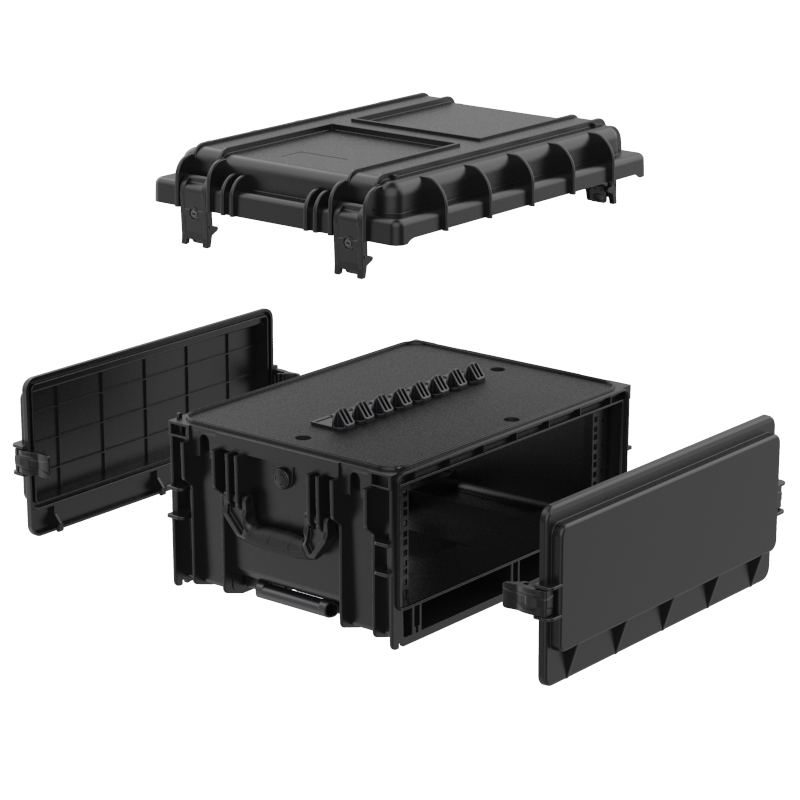
The most useful feature on a rack case is not visible in a photo: whether the case can come apart.
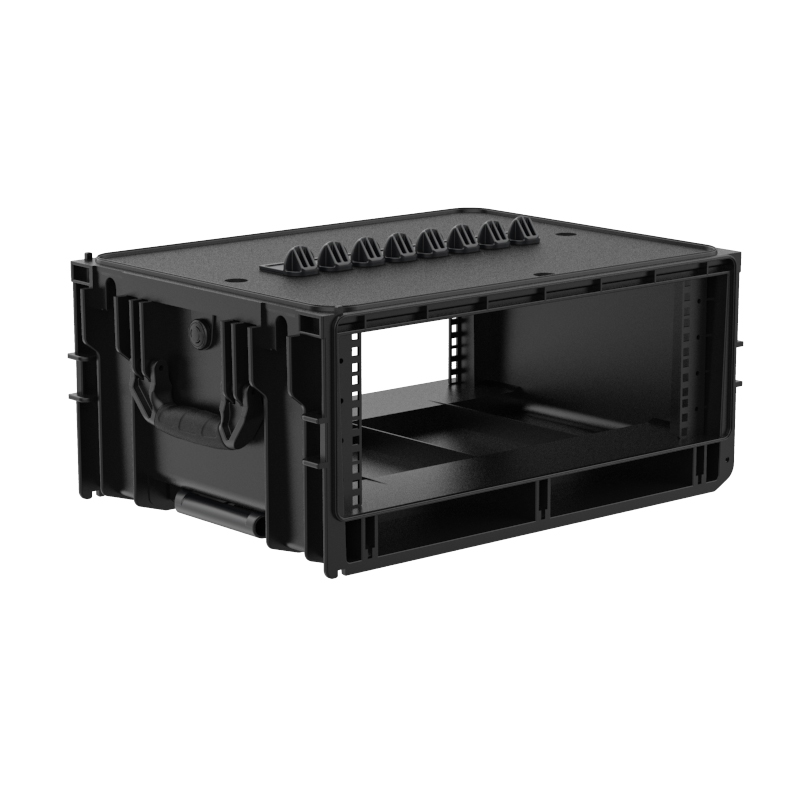
Tsunami’s 4U rack case is built as a collapsible structure. The shell separates so the rack can be deployed, cabled and serviced without working around a fixed lid, then re-assembled for transport. On a stage, in a truck pack or in a temporary control room, that turns a case from a box you unpack into a housing you can actually work in.
It also solves a storage problem. Empty shock racks consume the same floor space as loaded ones. A collapsible case does not.
Water, dust and the pressure valve everyone forgets
Two ratings matter, and they answer different questions.
IP67 is the one to look for on the spec sheet: the “6″ means fully dust-tight, and the “7″ means the case survives temporary immersion of 1 metre for 30 minutes. Tsunami’s rack case carries IP67 certification, along with dust and dry-heat certificates. That covers rain on a load-in, spray on a ferry, a wet deck, and the fine dust of a desert site or a construction dock.
A pressure equalisation valve is the second. Cases are not sealed at a constant pressure — they are sealed at whatever pressure they were closed at. Fly, or drive from sea level to altitude, and the difference pushes against the gasket: the lid either fights you open or stresses the seal. An automatic valve equalises slowly while keeping the case watertight. It is a small part that decides whether your case still seals after a hundred trips.
Sizing a 4U case: measure three things, not one
1. Rack units. 1U is 44.45 mm of vertical rack space, so 4U is about 178 mm of equipment height. Add up what you are actually mounting — a 1U receiver, a 1U interface and a 2U amplifier fills 4U exactly, with no room for a vent panel.
2. Depth. This is where most “it doesn’t fit” problems come from. Deep chassis gear and rear-mounted connectors need clearance behind the rails, and cables need bend radius. Measure the deepest unit with its connectors attached, then check it against the case’s external depth — Tsunami’s 4U case is 326 mm deep externally, so confirm your chassis depth before you commit.
3. Total travel dimensions. Tsunami’s 4U case measures 612 × 483 × 326 mm externally, which adds up to about 56 linear inches — under the 62-inch threshold most airlines use to separate standard from oversized baggage. That is a real cost difference on a touring schedule. Confirm your carrier’s current rule, because allowances change.
Weight is the fourth number worth knowing: 10.7 kg empty. Add the rack and the gear before you decide who carries it.
Details that decide whether it survives year three
Shell. Polypropylene body, ribbed for stiffness — engineered plastics with anti-ageing and anti-deformation properties rather than a thin cosmetic skin.
Seal. A rubber O-ring running the full perimeter. It is a wear item: wipe it, inspect it, and never store the case closed and wet.
Hinges and pins. Stainless steel pins instead of plastic, which is the difference between a hinge that still works after two winters in a van and one that seizes.
Mobility. Two casters and moulded handles, sized for a loaded case rather than an empty one.
Temperature. Rated from -40°C to +90°C, which covers a locked van in summer and an unheated cargo hold in winter.
Warranty. Lifetime on the body.
An honest note on range
Tsunami’s rack case line is deliberately focused: the 614832-4U is a 4U collapsible IP67 rack case, and that is the model we build at volume. If you need a different U height or depth, the practical routes are a modified insert and configuration, or a new mould — tooling runs roughly 60 days. Logo and colour customisation are available on standard production.
We would rather tell you that than imply a catalogue we do not have.
FAQ
Is a molded rack case as protective as a shock rack?
Not identical. A shock rack isolates with a suspended frame and is heavier; a molded case protects through shell rigidity, sealing and foam. For most touring audio, IT and broadcast gear, a molded IP67 case is the better trade because it actually gets carried and actually gets flown.
Can I fly with a 4U rack case?
At 612 × 483 × 326 mm the case measures about 56 linear inches, under the common 62-inch oversized threshold. Always confirm the specific carrier’s rule and current weight allowance.
What does “collapsible” mean in practice?
The shell separates so the rack can be deployed and serviced without a fixed lid in the way, then re-assembles for transport. It also means an empty case stores flat.
How do I stop condensation inside the case?
Seal it dry, never pack wet cables, and let the case air out after a humid load-out. A desiccant pack is cheap insurance for gear that sits for weeks between jobs.
Do you make other U heights?
The 4U is the standard model. Other heights mean a new mould, typically around 60 days — worth it for a recurring volume order, not for a one-off.
Pack it like freight, not like luggage
Tsunami has built waterproof, impact-resistant protective cases for over 17 years, from a factory of more than 55,000 m² running 38 injection-moulding machines, over 1,800 mould sets and capacity above 1,200,000 pieces per month — ISO9001-certified, with 74 patents behind the hardware.
See the 4U rack case or the wider rack case range, and send us your rack layout — U height, deepest chassis, connector clearance — and we will tell you whether it fits before you buy.

At the end of the article, there is a large release of the latest e-catalogue. Identify the QR code to download the plastic hard cases latest e-catalogue. Don’t miss it ~
Scan the QR code below to get the latest e-catalogue ~
E-mail: info@tsunamicase.com
WhatApp:+8619128989453
website:https:www.tsunamicase.com
Post time: Oct-19-2026