
Hard-Shell vs. Soft: How to Choose a Sports Equipment Transport Case That Survives Air Travel

Show up at a tournament with a bow knocked out of alignment, and nothing else you packed well matters. Airlines treat sporting gear shipped in soft-sided bags as “improperly packed” — the phrase comes straight from carrier policy, as reported by GolfPass — and when a limb snaps or a club head cracks, the claim is denied before it is ever filed. Golfers, archers, anglers, and hunters moving serious equipment through airports run into the same wall. A hard-shell sports equipment transport case is the straightforward answer: you arrive ready to compete instead of ready to argue with a claims desk.
Why soft-sided cases lose at the baggage carousel
Baggage handling is fast and indifferent. A golf bag, a bow case, or a rod tube is not handled gently because the contents cost money — it gets stacked under heavier luggage, run through conveyor turns, and shoved into a hold where speed beats caution.
Soft nylon or canvas absorbs almost none of that. The impact passes through the fabric and lands directly on your gear. A hard shell behaves differently: it takes the hit at the shell and spreads the force across the walls, so your equipment never meets the blow itself. That is the entire argument for a hard case — not the logo, not the color, just where the energy stops.
Hard-shell vs. soft-sided: what actually changes in transit
|
What happens in transit |
Soft-sided case |
Hard-shell sports equipment transport case |
|
Stacked under luggage |
Crushes inward; contents carry the load |
Rigid walls resist compression and hold shape |
|
Dropped on a loading dock |
Shock transfers straight to gear |
Shell absorbs impact; foam dissipates it |
|
Rides in a pressurized hold |
No defense against condensation |
O-ring seal plus pressure equalization valve keep moisture out and the lid easy to open |
|
Pulled for security screening |
Locks cut, zippers forced open |
TSA-accepted lock points let inspectors open and re-close without damage |
|
Repeated trips over years |
Fabric tears, zippers fail |
PP shell, stainless-steel hardware, lifetime body warranty |
The four ways gear gets damaged — and what defends against each
Almost all transit damage falls into one of four buckets. Match the feature to the failure, and the case choice becomes obvious.
1. Crushing. Bags packed on top press down hard. A rigid PP (polypropylene) shell with reinforced walls holds its shape, so the weight never reaches your equipment.
2. Shock. A case dropped sideways lands on whatever is inside. Closed-cell or precision-cut PU foam suspends gear so it rides on cushioning instead of hitting the wall.
3. Rattle. Loose equipment grinds against itself for hours. Pick-and-pluck foam locks each piece in place so nothing shifts or scratches in transit.
4. Moisture and altitude. Cargo holds are cold and damp, and pressure changes as the aircraft climbs. An O-ring seal keeps water out; an automatic pressure equalization valve stops the case from vacuum-locking shut so it opens easily on arrival. Look for a certified IP67 waterproof case — submersible in 1 meter of water for 30 minutes — not “splash-resistant.”
Match the case to your sport
The interior matters more than the outer shell. Here is how Tsunami’s line maps to the gear each sport actually carries.
Golf: protecting a full set
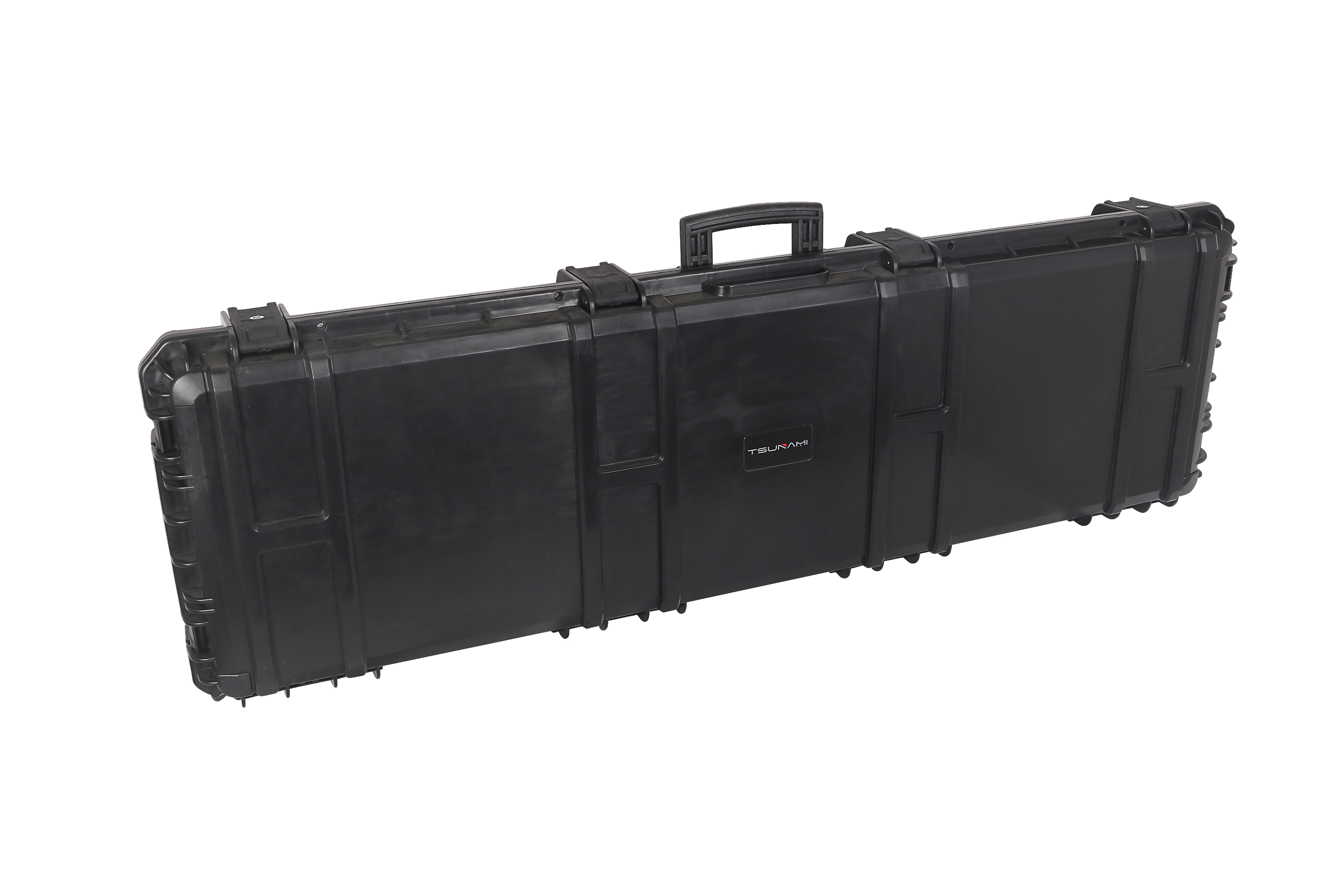
A fitted set of irons, a driver, and a putter represent real money — and checking that set in a soft travel bag puts it at risk. The 1224032 hard golf transport case is built around a complete set: a 1225 × 405 × 320 mm interior swallows clubs with head covers on, while the crushproof shell and a six-layer foam floor keep shafts from bowing under stacked luggage. Two built-in casters and a molded side handle roll it through terminals, TSA-ready lock points come standard, and the shell is rated from -40°C to +90°C (-40°F to 194°F). One golf travel case that keeps a set out of the repair shop pays for itself.
Archery: holding precision on the road
Compound bows, recurves, and crossbows hold accuracy to tight tolerances. A limb knocked out of alignment or a sight bumped loose means recalibration time a competitor simply does not have. Tsunami’s bow case lineup covers both ends of the range:
The B85 bow/gun case carries long items up to 850 mm in an 865 × 300 × 124 mm interior, with egg foam top and bottom, sliding latches, and a 7 mm padlock hole. It suits compact compound bow case setups that need dependable protection (rated -10°C to 60°C).
The B120 runs longer and slimmer at 1210 × 228 × 102 mm — ideal for slim archery case and crossbow case profiles, arrows, and accessories, without letting anything rattle. Lightweight PP + fiber holds the empty weight to 2.4 kg.
Both carry TSA-ready padlock points and a limited lifetime warranty on the body.
Fishing: rods arrive in one piece or not at all
A fly rod headed to a remote river cannot be replaced at the destination if it arrives cracked. A purpose-built hard rod case keeps a multi-piece rod and reel straight and protected for the whole trip, while a compact 231408 personal utility tackle box keeps flies, hooks, and tools organized alongside it. For fishing rod case buyers, interior length is the first number to check.
Hunting and firearms: protection plus legal compliance
Hunters flying with firearms need a lockable hard case that satisfies carrier and TSA rules — this is compliance, not just protection. Tsunami builds for it:
The 1283715 waterproof gun case carries scoped rifles in a 1280 × 370 × 150 mm interior with an IP67 seal, eight latches, and two wheels — a genuinely waterproof rifle hard case for trips and long-term storage.
The 933615 outdoor gun case covers shorter rifle and shotgun setups in a 930 × 356 × 152 mm interior, also IP67-rated with two casters.
The Lock 8616 TSA-approved case lock (alloy steel, 6 mm shackle, three-dial combination, Travel Sentry approved) closes the loop — security staff can open and relock without cutting hardware.
TB-series ammo boxes — such as the TB908 (155 × 80 × 80 mm, 100 rounds) and TB909 (155 × 80 × 95 mm, 50 rounds) — carry ammunition, tools, and accessories separately.
Our waterproof gun case and rifle case ranges are dimensioned around the equipment, not adapted from a generic shell.
Airline and TSA compliance: check before you book
Hard-sided is the baseline. Many carriers extend liability coverage for sporting equipment only when it is packed in a hard-sided case. Confirm the policy for your specific airline before booking.
Lock rules differ by cargo type. Firearms must be declared and transported in a locked, hard-sided case; use a TSA-accepted lock on any case security may need to inspect.
Know your lock. Non-locking latches can often be swapped for TSA-locking ones, and reinforced padlock loops accept any standard TSA travel padlock.
Check dimensions, not assumptions. Make sure the case’s exterior fits standard checked-baggage limits and its interior fits your gear with foam on every side.
The 6-point buyer’s checklist
1. Shell material. Polypropylene flexes and absorbs impact; thin injection-molded plastic can crack under a sharp hit.
2. Waterproof rating. A certified IP67 seal is the real thing — “splash-resistant” is not.
3. Latch and lock system. Recessed latches resist snagging on conveyors; TSA-accepted lock points are a must for checked gear.
4. Pressure relief. An automatic equalization valve keeps seals intact and lids easy to open after a flight.
5. Mobility. Two to four casters and a molded handle hold up under a loaded case; a single strap wears out fast.
6. Warranty. Tsunami backs every hard case with a lifetime warranty on the body.
FAQ
Do airlines require hard-sided cases for sports equipment?
Many carriers strongly recommend or require hard-sided cases to extend liability coverage. Soft-sided damage claims are frequently denied. Verify your airline’s specific policy before you book.
Are Tsunami cases TSA-compliant?
Yes. Tsunami cases include reinforced stainless-steel padlock loops that accept standard TSA travel padlocks, so security can open and re-secure a case without cutting hardware. TSA-approved padlocks are available separately.
What temperature range can Tsunami cases handle?
Most Tsunami hard cases are rated from -40°C to +90°C (-40°F to 194°F). Ratings vary by model — the compact B85 bow case, for example, is rated -10°C to 60°C — so confirm the spec on each product page for extreme conditions.
Can one case carry more than one type of gear?
Often, yes — with the right foam layout. For equipment with tight dimensional needs, such as compound bows or a full golf set, a purpose-built case fits and protects better than a general-purpose one.
How do I pick the right size?
Match the interior dimensions to the longest, widest, and deepest part of your gear, then leave room for foam on all sides. Every Tsunami product page lists detailed interior measurements — or contact us and we will help you spec the right setup.
Built for the trip, not just the shelf
Tsunami has manufactured waterproof, impact-resistant protective cases for over 17 years, from a 55,000 m² factory running 38 injection molding machines, more than 1,800 molds, and capacity above 1,200,000 pieces per month — ISO9001-certified and backed by 74 patents. That background shows up in the details that matter on the road: shell rigidity, latch reliability, foam precision, and hardware that holds up across years of use.
For golf, archery, fishing, or hunting, shop sports transport cases built to handle every trip. Need a custom foam insert or a specific interior layout? Contact our team and we will help you spec the right case for your equipment.
Pack it right the first time.

At the end of the article, there is a large release of the latest e-catalogue. Identify the QR code to download the plastic hard cases latest e-catalogue. Don’t miss it ~
Scan the QR code below to get the latest e-catalogue ~
E-mail: info@tsunamicase.com
WhatApp:+8619128989453
website:https:www.tsunamicase.com
Post time: Sep-10-2026