
Case With Foam Insert: When an Industrial Kit Actually Needs One

Foam is the cheapest part of a protective case and the part most often specified badly. Buyers either assume every industrial case needs a custom interior, or they buy an empty shell to save money and discover on the first service call that the instrument arrived with a cracked display bezel and three missing probes.
The useful question is not “foam or no foam”. It is what has to be true inside the case for your equipment to arrive working, and who has to be able to confirm that in ten seconds. That answer changes the interior specification — and sometimes it tells you foam is the wrong choice entirely.
Three questions that decide the interior
Before choosing a cavity layout, answer these. They are ordered by how much they change the outcome.
1. Does the kit repeat? If the same equipment, probes and cables get packed the same way by different technicians, a fixed interior is an asset: it removes judgement from packing. If the contents change weekly — different instruments, different accessories, different job — a fixed interior becomes a constraint you fight.
2. What does the equipment actually mind? A calibrated instrument cares about shock direction and mounting points, not about being touched. A sealed sensor housing cares about water and dust. A display or an optical bench cares about point loads and about anything resting on it. Foam is good at distributing load and separating items; it is not a substitute for knowing where the fragile area is.
3. Will someone check completeness? In field service, the most expensive failure is not a broken component — it is a missing one, discovered 400 km from the depot. An empty cavity is the fastest possible checklist, because absence is visible. That operational benefit is usually worth more than the foam’s cost.
If the answer to all three is “no”, you probably do not need a custom interior.
Where a foam insert earns its cost
|
Situation |
What the foam is really doing |
What to specify |
|
Instrument plus accessories travel as one kit |
Keeps probes, power supplies and cables from colliding with the main unit |
Separate cavities per item; identify each cavity |
|
High-value or calibrated equipment |
Removes movement and rattle; stops point loads on panels |
Full-contact cavity walls; correct foam density per item weight |
|
Same kit issued to multiple technicians |
Makes packing independent of the person doing it |
Fixed layout, marked positions, standard load order |
|
Repeated units for OEM delivery |
Makes every shipment identical, so a customer sees the same unboxing every time |
Repeatable cut program, retained drawings, per-unit verification |
|
Kit must be checked fast |
Turns “is everything here?” into a visual scan |
One item per cavity, nothing double-stacked |
|
Kit crosses modes — van, air, courier |
Holds the layout through handling that is rougher than your own staff’s |
Compression fit, retention in the lid layer, no loose items above the gasket line |
The common thread is not protection alone. It is removing decisions from the people who handle the case. A good interior makes the correct packing the only convenient packing.
Four situations where foam is the wrong answer
This is where most specifications go wrong, because a custom interior feels like a premium upgrade and gets added by default.
The kit changes constantly. If the case carries a different instrument every week, a cut cavity fits yesterday’s job. Dividers or a configurable interior reconfigure in a minute and cost nothing to change later.
The item is heavy and mounted, not carried loose. Equipment with feet, brackets or a chassis designed to be bolted down does not need to be cradled. It needs a rigid base and restraint. Foam under a 20 kg unit compresses, the unit settles, and the cavity that fitted at packing is loose by the time it arrives.
The item needs inspection or airflow. If a unit must be opened, connected or powered while it sits in the case, or if it dissipates heat in use, a closed foam cavity is the wrong environment. Lid organisation, panels and openings do that job better than foam.
The case is a returnable shipping container, not a presentation box. In a closed logistics loop, cycle count matters more than the first unboxing. Interiors that survive 200 trips are usually simpler, thicker and less detailed than interiors designed for one impressive delivery — and the specification should say which one you are buying.
The numbers that change the cut
Two cases can share an external footprint and need completely different interiors. The variable is depth, and depth is not one number.
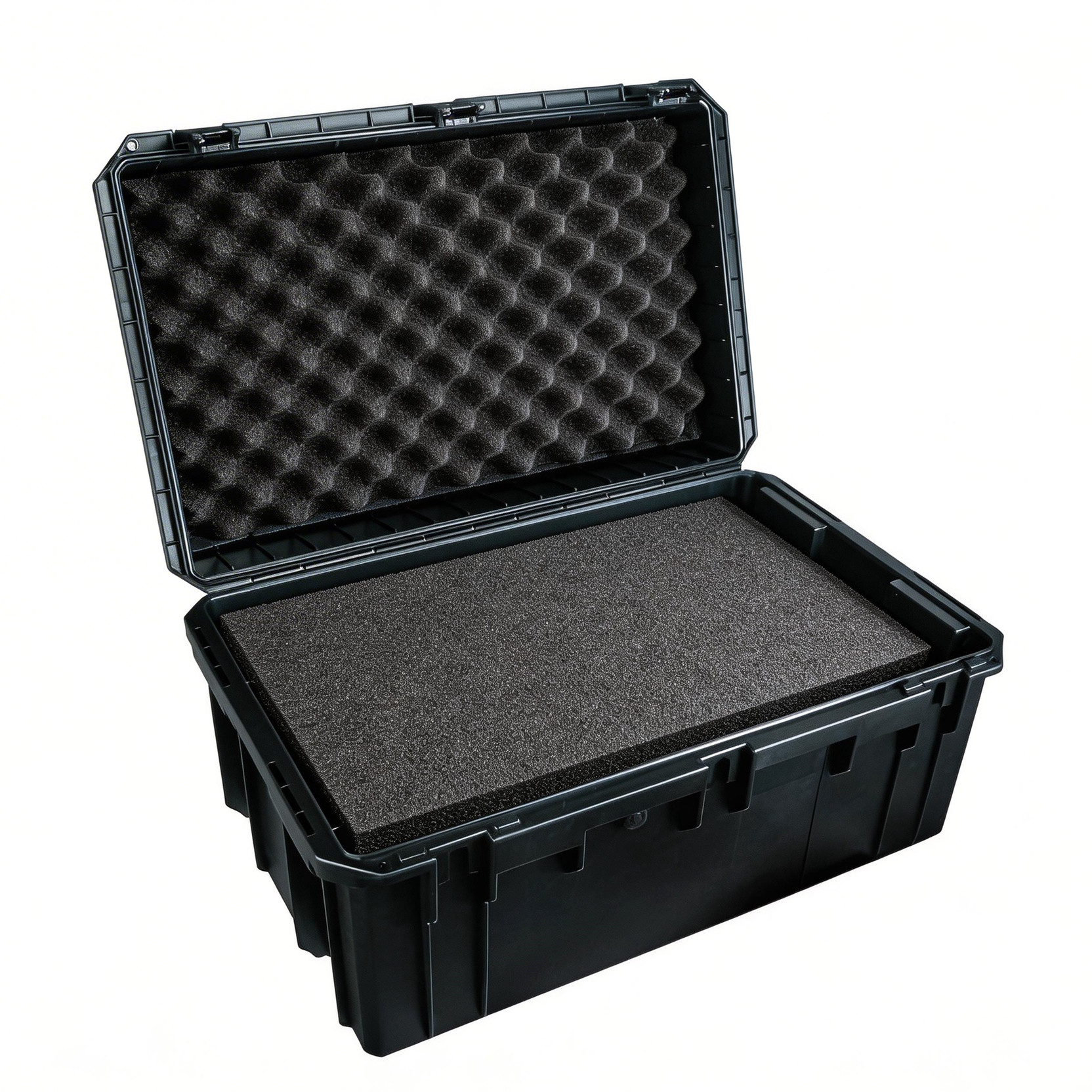
Take the 584433: 651.5 × 508.3 × 355.5 mm externally, 580.6 × 439.6 × 328 mm internally, at 84.3 litres. Of that 328 mm total depth, 273 mm is the base and 55 mm is the lid. Those two figures decide the whole layout:
Anything standing upright must fit under 273 mm, plus whatever foam you remove — not under 328 mm.
The 55 mm lid is not storage space for heavy items. It is where a thin retention layer, flat accessories or documentation live.
The interior ships with four foam layers, which is what makes multilayer layouts possible: base cushion, cavity layer, retention layer, lid liner.
The same principle shows up at the other end of the range. The 443419 is 444.7 × 345.8 × 190 mm internal (18.6 L) with a 143 mm base and 47 mm lid and three foam layers — a compact instrument kit with a shallow lid that will not accept a stacked accessory box. The 322505 is a flat 325 × 233 × 43 mm internal at 3.26 litres, with two foam layers: a format for tablets, panels and flat instruments, where a deep cavity would be wasted volume.
Three further inputs matter as much as depth:
Item weight per cavity. A heavy item needs a denser foam and a larger contact area, or it will migrate. Very light items need the opposite — foam stiff enough to hold them can also mark a soft finish.
Load direction. What the case does when it is dropped on a corner is different from what it does when 40 kg of other freight sits on top of it. The cavity needs to hold in both, which usually means the retention comes from the lid layer, not from friction.
Compression. The interior should close with slight compression, so the equipment cannot move but the latches are not fighting the foam. If the lid needs body weight to latch, the cavity is cut too shallow and the shell is being pre-loaded instead of protecting anything.
Where a foam insert stops and the system starts
In an industrial case, the interior is only one layer of the design. What surrounds it does the rest of the work:
Lid organisation — documents, cards, small parts and the accessory set that would otherwise rattle loose.
Dedicated compartments — a separate bay for cables and chargers so nothing sits on top of the instrument cavity.
Panels and connection points — for equipment that is operated or wired while in the case.
Openings and ventilation — for units that run warm or need pressure or cable access.
Identification — a nameplate, asset number, or customer branding applied to the shell rather than a label that peels off in a van.
Tsunami builds these as options around a standard shell: personalised nameplate service, custom logo, custom insert, colour and material selection, and new moulds where a standard size does not fit the equipment. Typical lead times on the current program are around two weeks for a customised insert sample, around one week for a logo sample, around 60 days to open a new mould, and around 20 days for bulk production.
Same shell, three different interiors
This is the part that surprises buyers new to industrial cases: the case is the standardised half. The interior is the customised half.
Using the 584433 as a platform — 84.3 litres, IP67, four latches, two casters, 10.92 kg with foam against 9.65 kg empty — three projects would specify three different interiors from the same shell:
A service instrument with probes and a power supply. Deep cavities in the base for the instrument and the supply, a shallow channel for probes along one wall, and a lid layer holding calibration paperwork and a cable. Priority: nothing touches the instrument’s front panel.
A multi-part kit issued to several technicians. Uniform cavities with marked positions so every kit can be checked by eye, and a lid compartment for consumables that are re-ordered rather than repaired. Priority: completeness verification.
A heavy unit that ships inside the case as packaging. A base of dense foam carrying the load directly under the chassis, restraint from above, and no cavity under the feet. Priority: repeatability across hundreds of shipments, not presentation.
Same shell, same seal, same latches. The interior is where protection becomes specific — and where an OEM shipment either arrives identical every time or does not.
What to send a supplier before anyone cuts foam
A custom interior is only as good as the brief. Six items remove almost all of the back-and-forth:
1. Drawings or a 3D model of each item, including anything that protrudes — a connector, a knob, a mount.
2. Weight and centre of gravity per item, not just total kit weight.
3. Depth budget per item, measured as packed, against base depth rather than total depth.
4. Access direction — does the technician open the lid and lift, or reach in from the front?
5. Quantity and repeatability — one prototype, a pilot batch, or a recurring production run. This decides whether the interior is cut as a one-off or documented as a repeatable program.
6. Transport modes and marking — courier, air freight, sea freight, internal van loop; and what the case must say on the outside.
Add the compliance documents you need to hand to your own customer. Tsunami issues IP67, dust and dry heat certificates with the case, which is a different thing from a waterproof claim on a brochure.
FAQ
What makes a foam insert necessary rather than optional?
When the same kit travels repeatedly, contains sensitive or calibrated equipment, includes accessories that must be separated, and needs to be verified quickly by whoever opens the lid. If the contents change every week, a configurable interior usually serves better.
Is pre-cut foam or custom-cut foam better for industry?
Pre-cut or grid foam suits early-stage projects and kits still being defined, because it can be adjusted without new tooling. Custom-cut foam suits a fixed configuration where the layout has to be identical across units and over time.
How many layers can an industrial case interior have?
It depends on depth. The 584433 ships four foam layers across a 273 mm base and 55 mm lid; the 443419 ships three across a 143 mm base and 47 mm lid. More layers mean more flexibility in cavity depth, but also more places for a cut to be wrong.
Do heavy instruments need foam under them?
Usually not directly under the load path. A heavy unit is better carried on a dense base layer with restraint above it, so it cannot settle into a cavity that was cut to its shape when it was empty of accessories.
Can the case itself be customised, not just the foam?
Yes. Standard shells can take custom inserts, colours, logos, nameplates and material options, and a new mould is an option where no standard size fits. On the current program, a customised insert sample runs around two weeks and a new mould around 60 days.
Conclusion
A foam insert is worth paying for when it removes judgement, movement and doubt: the packing is the same every time, nothing shifts in transit, and a missing probe is visible at a glance. It is not worth paying for when the kit changes weekly, when the unit is mounted rather than carried, or when the case has to survive a returnable logistics loop rather than a single impressive delivery.
Tsunami builds the shell and the interior as one specification: PP + fiber bodies, continuous O-ring sealing with pressure equalisation, IP67-rated models with published test certificates, interiors offered in custom foam, cubed foam, empty or divider layouts, and OEM options for inserts, colours, branding, nameplates and new moulds. Every hard case carries a lifetime warranty on the body.
Talk to us about an industrial case program — send drawings, weights and quantities, and we will come back with a cavity layout rather than a catalogue page.

At the end of the article, there is a large release of the latest e-catalogue. Identify the QR code to download the plastic hard cases latest e-catalogue. Don’t miss it ~
Scan the QR code below to get the latest e-catalogue ~
E-mail: info@tsunamicase.com
WhatApp:+8619128989453
website:https:www.tsunamicase.com
Post time: Nov-12-2026