
Waterproof Cases for Scuba Diving and Underwater Photography: Which Gear Actually Needs One
Dive kit splits into two groups, and they want opposite things. Wetsuits, fins, BCDs and masks are built to be soaked, dragged across a boat deck and hung up dripping. Camera bodies, underwater housings, ports, strobes, dive computers, batteries and chargers are the opposite: a single splash in the wrong place can end the trip.
Most divers pack both groups the same way — one big bag, everything thrown in together. That works until the day it doesn’t. The fix is not to buy a hard case for all your gear. It is to decide which part of the kit deserves rigid, sealed protection, and to stop treating it like laundry.
The wet/dry split: what actually needs a hard case
|
Gear |
Designed to get wet? |
Needs a sealed hard case? |
Why |
|
Wetsuit, fins, BCD, mask, hood, boots |
Yes |
No |
Needs to drain and dry; a sealed box would trap water and smell |
|
Regulator, gauges, SPG |
Yes (rinsed after every dive) |
No — padded bag |
Rinse water must escape; a sealed case keeps it in |
|
Dive computer, torch, spare batteries |
No |
Yes |
Electronics and contacts corrode fast in salt air |
|
Camera body, housing, ports, O-rings |
No |
Yes |
Housings work on clean, undamaged seals — not on grit |
|
Strobes, arms, cables, chargers, cards |
No |
Yes |
Hard to replace mid-trip, easy to lose, easy to crush |
The pattern is simple: if rinsing it in fresh water is part of its routine, it does not belong in a sealed case. If a splash ends its life, it does.
What a dive bag does well — and where it stops
A mesh or duffel dive bag is genuinely good at its job: heavy wet loads, sand falling out the bottom, air moving through so nothing mildews on the ride home. Keep using it for that.
Where a bag stops is everything after “wet.” A soft bag absorbs none of an impact — a dropped bag puts the shock straight into whatever is underneath the padding. It offers no barrier against salt spray on an open boat, rain during a surface interval, or the damp of a liveaboard cabin. And it does nothing against the two things that quietly kill dive electronics: humidity that never leaves, and grit that finds a housing’s O-ring at exactly the wrong moment.
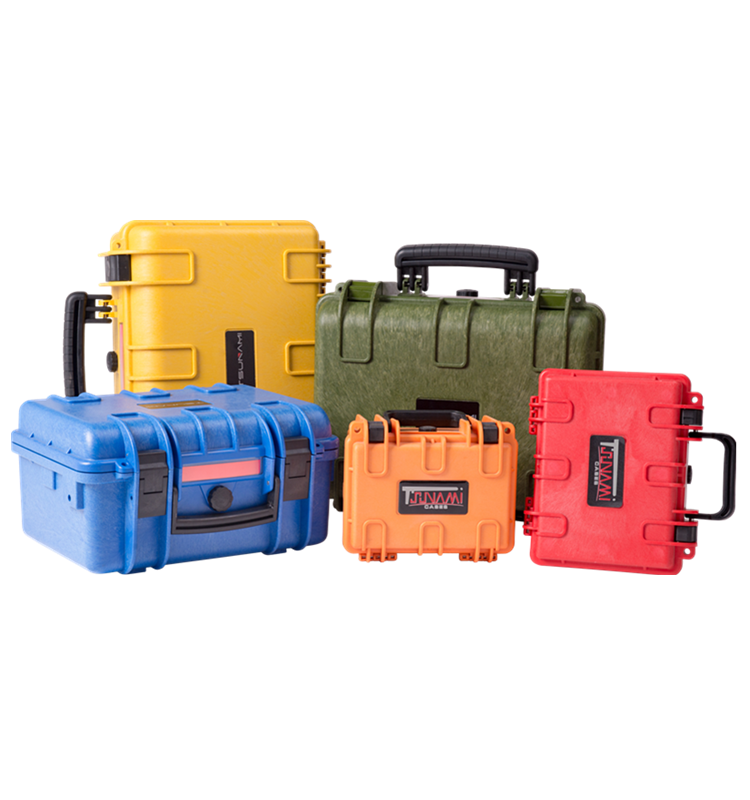
That is the job a rigid, sealed waterproof case does — and only that job. It is not a replacement for your mesh bag. It is the part of your kit that arrives exactly as you packed it.
What IP67 actually means — and the mistake it invites
Case marketing leans hard on a two-digit code, so it is worth knowing what the digits promise.
6 — the highest solids rating: fully dust-tight. Sand, road grit and dried salt cannot get in.
7 — the case survives temporary immersion: 1 metre of water for 30 minutes.
Together that covers rain, spray, wet decks, a dunked case off a rib, and the inside of a humid liveaboard locker. Tsunami’s sealed camera and equipment cases carry IP67 certification documents, along with dust and dry-heat certificates.
But an IP67 case is not an underwater housing. This is the single most expensive misunderstanding in dive photography. A sealed case protects your gear during transport, on the boat, on a wet deck, and in a wet vehicle. It is not rated to go to 30 metres with a camera inside, and it is not designed to be pressurised by depth. For the water itself you still need a dedicated housing with its own seals and its own service schedule.
Why salt water changes the hardware spec
Fresh water is forgiving. Salt water attacks metal, thread and anything that can corrode, and it does it faster than most people expect. Two specifications matter more on a dive boat than anywhere else:
Stainless steel pins and hinges. Tsunami cases use stainless hinge pins rather than plastic, which is the difference between a hinge that survives a season of salt exposure and one that seizes.
A rubber O-ring gasket running the full perimeter of the lid. This is the seal. It is also a wear item: a single grain of sand or dried salt sitting on the gasket will defeat it. Inspect and wipe the gasket before every trip — and never store the case closed and wet.
An automatic pressure equalization valve matters too. It lets the case balance internal pressure without breaking the seal, so the lid still opens after a hot afternoon on a boat deck or a pressurised aircraft hold, instead of fighting you with a vacuum.
Before the dive: the case becomes your checklist
Underwater photography has a lot of small, essential parts, and they are all easy to leave behind: camera, housing, port, O-rings, grease, batteries, memory cards, strobes, fibre-optic cables, chargers, clamps, arms.
A divided or foam-lined interior turns that list into something you can verify at a glance instead of by memory. Open the case, see the empty slot, find the missing cable before you are on the boat. That is the real value of a camera case with dividers or precision-cut foam: not just protection, but a pre-dive check that takes seconds instead of ten anxious minutes.
Our rule for the liveaboard deck: pack it, check it, seal it, dive.
Matching the case to the kit
Compact housing kit — 443419
444.7 × 345.8 × 190 mm interior, 18.6 litres, 4.9 kg with foam. IP67, and resistant to UV, solvents, corrosion and fungus to MIL-STD-810F — a standard written for humid, salty, hostile environments, which is exactly a dive boat. Choose custom dividers you can re-cut as your kit changes, or three layers of foam. Two latches, a lock hole, an O-ring seal and a pressure valve. No wheels, so it travels in a bigger case or on your back.
Growing kit on wheels — 533120
530 × 310 × 200 mm interior, 32.8 litres, 5.75 kg with foam, four foam layers, four latches. IP67, two silent casters and a retractable pull rod, so a loaded case moves across a dock, a car park or a rough track without being carried. Also 7 mm padlock holes and a stainless steel hinge — the two details that matter most on a boat.
Long kit: arms, poles, strobe supports — 1303214
1308 × 321 × 133 mm interior, 55.84 litres, 8.4 kg with foam. A long-format IP67 case for equipment that does not fit a square box: lighting arms, booms, poles, tripods and supports. Six latches, two casters, three foam layers, and space for components up to about 50 inches.
Smaller foam-lined kit — 433015
421 × 292 × 139 mm interior, waterproof, dustproof and shockproof, with foam. A sensible step down when you are carrying one compact housing and a pair of strobes rather than a full kit.
Every model above carries a limited lifetime warranty on the body, and foam or dividers can be cut to your measurements — samples in about two weeks.
FAQ
Is an IP67 case enough to take a camera underwater?
No. IP67 means dust-tight and rated for temporary immersion (1 m for 30 minutes) — it protects your gear in transit and in wet environments. A dedicated underwater housing is still required the moment the camera goes beneath the surface.
Can I put a wet wetsuit or rinsed regulator in a hard case?
Don’t. A sealed case traps water and humidity, which is how gear rusts and mildews. Keep wet items in a mesh bag that drains and breathes.
Why did my sealed case let water in?
Almost always the gasket. Sand, dried salt or a hair on the O-ring is enough to break the seal. Wipe the gasket before each trip, keep the case open and dry in storage, and check that the valve is clear.
Can I fly with a dive camera case?
Yes. Each case has 7 mm padlock holes built for TSA-accepted locks, so security can open and re-close it without cutting hardware. Carry the housing and camera with you where the airline allows it; check the heavy case and put the irreplaceable glass in the cabin.
Will a hard case fit in a car with the rest of the dive kit?
That is what the widths are for. The 443419 is the most compact (474 mm external), the 533120 rolls (545 mm), and the long 1303214 is 1387 mm — worth measuring against your boot before you commit.
Built for water, salt and the ride between dives
Tsunami has manufactured waterproof, impact-resistant protective cases for over 17 years, from a factory of more than 55,000 m² running 38 injection-moulding machines, over 1,800 mould sets and capacity above 1,200,000 pieces per month — ISO9001-certified, with 74 patents behind the hardware.
Browse waterproof cases for cameras or the full camera case range, or tell us what you carry and we will match the interior to it.
Keep the wet gear wet, the dry gear sealed, and the O-ring clean.

At the end of the article, there is a large release of the latest e-catalogue. Identify the QR code to download the plastic hard cases latest e-catalogue. Don’t miss it ~
Scan the QR code below to get the latest e-catalogue ~
E-mail: info@tsunamicase.com
WhatApp:+8619128989453
website:https:www.tsunamicase.com
Post time: Oct-15-2026